Council land disposals: below value, decided urgently, and still to come
Councils' own papers record 1,603 disposals of land or buildings at less than best value since 2016, 37% of them for £1, nil or a peppercorn. 32 disposal decisions were taken under urgency, and 1,938 sites have been declared surplus since January 2024.
1,603council land and building disposals at less than best value in councils' own papers, 2016 to 2026
By Institrace. Published .
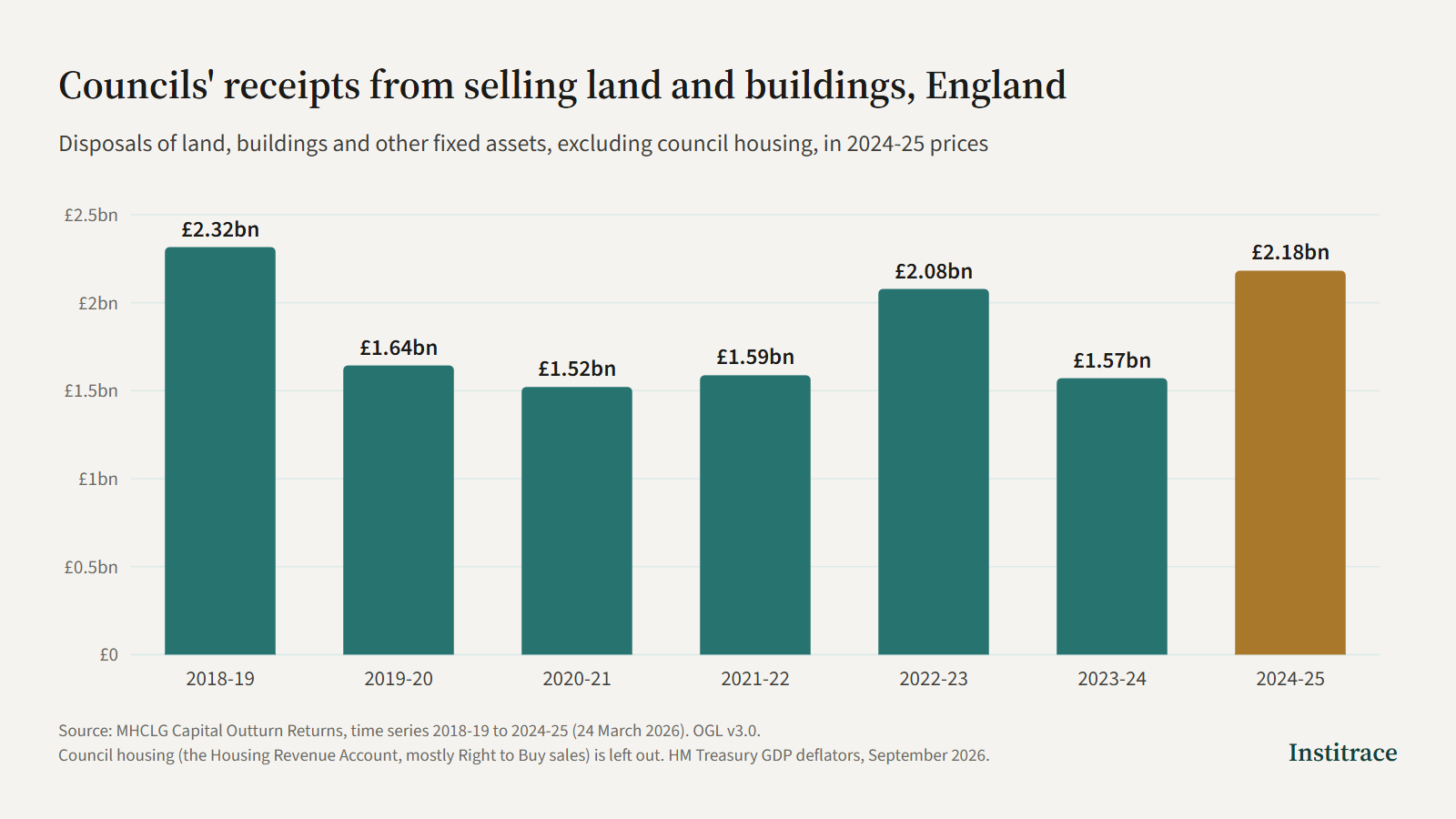
The figures as a table
| Financial year | Cash | In 2024-25 prices | Council housing (left out) |
|---|---|---|---|
| 2018-19 | £1.83bn | £2.32bn | £1.28bn |
| 2019-20 | £1.33bn | £1.64bn | £1.12bn |
| 2020-21 | £1.29bn | £1.52bn | £0.90bn |
| 2021-22 | £1.36bn | £1.59bn | £1.28bn |
| 2022-23 | £1.90bn | £2.08bn | £1.38bn |
| 2023-24 | £1.51bn | £1.57bn | £0.95bn |
| 2024-25 | £2.18bn | £2.18bn | £1.15bn |
Findings
English councils received £2.18bn in 2024-25 from selling land, buildings and other fixed assets, leaving out council homes sold under the Right to Buy. That is the most in any year since 2018-19 in cash terms; in 2024-25 prices it is second to 2018-19's £2.32bn. Over the seven years councils took £11.4bn in cash this way. In the same years they spent between £2.0bn and £4.4bn a year buying land and existing buildings, homes for council housing included.
The returns councils send the Ministry of Housing, Communities and Local Government give a total for each council and year. They do not say what was sold, to whom, or on what terms. Councils' own papers do. Institrace holds 3,826,497 papers from English, Scottish and Welsh councils published since January 2016, and read 20,213 of them for this report: every paper that names a disposal below best value, every paper since January 2024 that declares land or buildings surplus, and a sample of papers naming an urgency route.
Three findings follow. Since 2016, councils' papers record 1,603 disposals of land or buildings at less than best consideration, at 216 councils, most of them to community groups, parish and town councils, housing associations, charities and sports clubs. 32 land disposal decisions were taken under urgency, about one in fifty. And since January 2024 councils have declared or proposed 1,938 sites surplus, 1,692 of them with no sale agreed in the papers so far.
The councils with the largest receipts over the seven years are Barking and Dagenham (£571m), Birmingham (£439m), Hackney (£244m) and Croydon (£223m). Birmingham's receipts outside council housing rose to £220m in 2024-25, the year after it issued a section 114 notice. Croydon has issued section 114 notices since 2020. A council's total depends on its size and on what it owns, and a large figure can reflect a regeneration programme as readily as a programme of sales.
Councils with the largest receipts from selling land, buildings and other fixed assets, excluding council housing, England, 2018-19 to 2024-25 (cash)
| Council | Receipts, seven years | Capital spending, seven years |
|---|---|---|
| Barking & Dagenham | £571m | £2,766m |
| Birmingham | £439m | £2,968m |
| Hackney | £244m | £1,382m |
| Croydon | £223m | £1,102m |
| Merton | £215m | £186m |
| Surrey | £181m | £1,661m |
| Leeds | £160m | £2,276m |
| Nottingham | £159m | £1,139m |
| Westminster | £146m | £2,279m |
| City of London | £141m | £896m |
| Manchester | £137m | £2,369m |
| Southwark | £134m | £2,404m |
Below value
A council must usually sell or lease land for the best price it can reasonably get, under section 123 of the Local Government Act 1972 in England and Wales and section 74 of the Local Government (Scotland) Act 1973. It may accept less where the disposal helps the area's economic, social or environmental wellbeing. In England, the General Disposal Consent 2003 lets a council do so without asking the Secretary of State where the undervalue is £2 million or less.
Councils' papers record 1,603 such disposals since January 2016, at 216 councils in England, Scotland and Wales. Each counts once, however many reports, agenda packs and minutes record it. 1,091 name the General Disposal Consent and 77 the Secretary of State's own consent. 710 were leases, 399 freehold sales and 398 asset transfers. 600 (37%) were for £1, nil consideration or a peppercorn rent.
Most went to community and public-interest bodies: 260 to community groups, 239 to parish and town councils, 138 to housing associations, 121 to charities and 117 to sports clubs. 150 went to developers and other companies, often as part of a regeneration scheme or to enable affordable housing.
Examples. In July 2024 Worcester's papers set out a 99-year lease of the Swan Theatre at a peppercorn rent to Worcester Theatre, recording the theatre's existing use value as £1.6m (paper). North Yorkshire proposed in December 2020 a 30-year peppercorn lease of the World of James Herriot centre in Thirsk to the company that runs it (paper). Basingstoke and Deane agreed in June 2016 to sell the former Paddock Road surgery site to Sovereign Housing Association for affordable homes (paper). In 2019 Milton Keynes's papers set out the transfer of open space and woodland to West Bletchley Council for £1 (paper).
Some disposals are reviewed later. In December 2025 Peterborough's statutory officers reported to its executive, under section 5A of the Local Government and Housing Act 1989 and section 114A of the Local Government Finance Act 1988, on the council's 2020 transfer of the John Mansfield Centre to a foundation for £1; the 2019 delegated decision recorded the centre's book value as £4.6m (paper).
The number recorded each year at the councils whose papers Institrace holds for every year since 2016 has stayed between 86 and 146 a year, with no steady rise or fall. Dumfries and Galloway has the most in its papers, 69.
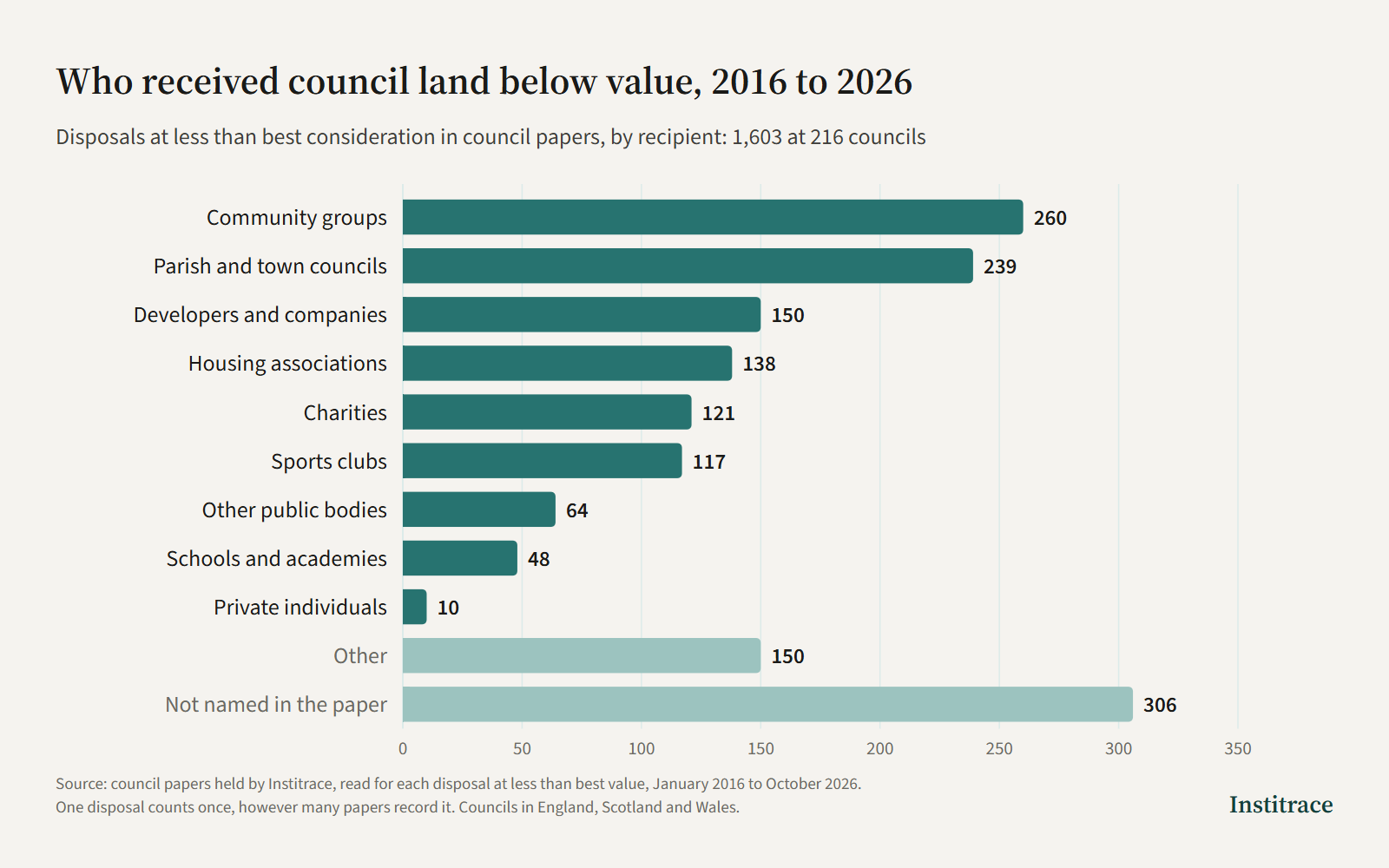
The figures as a table
| Recipient | Disposals |
|---|---|
| Not named in the paper | 306 |
| Community groups | 260 |
| Parish and town councils | 239 |
| Developers and companies | 150 |
| Other | 150 |
| Housing associations | 138 |
| Charities | 121 |
| Sports clubs | 117 |
| Other public bodies | 64 |
| Schools and academies | 48 |
| Private individuals | 10 |
Councils with the most disposals at less than best consideration in their papers, January 2016 to October 2026
| Council | Disposals | For £1, nil or a peppercorn | Approved or completed |
|---|---|---|---|
| Dumfries and Galloway | 69 | 49 | 12 |
| West Northamptonshire | 50 | 26 | 28 |
| Kirklees | 48 | 23 | 18 |
| Liverpool | 44 | 16 | 25 |
| Greenwich | 43 | 18 | 15 |
| Derbyshire Dales | 34 | 9 | 30 |
| Wakefield | 31 | 13 | 21 |
| Tandridge | 27 | 0 | 1 |
| Milton Keynes | 27 | 16 | 5 |
| Manchester | 27 | 1 | 12 |
| Slough | 25 | 2 | 16 |
| Hackney | 24 | 2 | 3 |
| North Yorkshire | 23 | 12 | 2 |
| Breckland | 23 | 20 | 14 |
| Barnet | 22 | 11 | 12 |
Decided urgently
Most council decisions follow a published timetable: key decisions are notified 28 days ahead, and a decision by the executive can be called in for review by councillors before it takes effect. Councils can shorten this when a decision cannot wait, through the general exception and special urgency rules of the 2012 regulations on executive arrangements, an urgent decision by a named officer or member, or by waiving call-in.
Across 212 councils whose papers Institrace holds for every year from 2016 to 2025, papers recording a decision taken under urgency ran at about 4 in every 1,000 from 2016 to 2019. The rate rose to 10.9 in 2020, the first year of the pandemic, was 7.0 and 7.3 in 2021 and 2022, and has been 4.7 to 5.2 since 2023: a little above the years before 2020.
Land disposals are rarely decided this way. Of the papers on below-value disposals, 923 mention an urgency route or call-in; 58 of them tie urgency to a land or property disposal, recording 32 disposal decisions since 2016, about one in fifty. Of these, 13 waived call-in, 12 were urgent decisions, 5 used special urgency and 2 the general exception.
The reasons given are mostly deadlines set by others. Sefton's 2017 land transfers to two colleges were taken under special urgency because of the start of the academic year (paper). Leeds waived call-in for a lease at Leeds Media Centre in December 2020 to meet the timetable of a European funding appraisal (paper). West Northamptonshire took an urgent decision in July 2025 so that a new Aldi store at Abbey Retail Park in Daventry could open before Christmas (paper). Islington used the general exception in September 2024 to accept the surrender of leases at Old Street when a tenant faced administration (paper).
Slough accounts for 5 of the 32, all in 2023 and 2024, during the asset sales that followed its 2021 section 114 notice; its February 2023 decision on Montem Lane cites an exchange of contracts due the next day (paper). Hyndburn accounts for 4, on parks and playing fields.
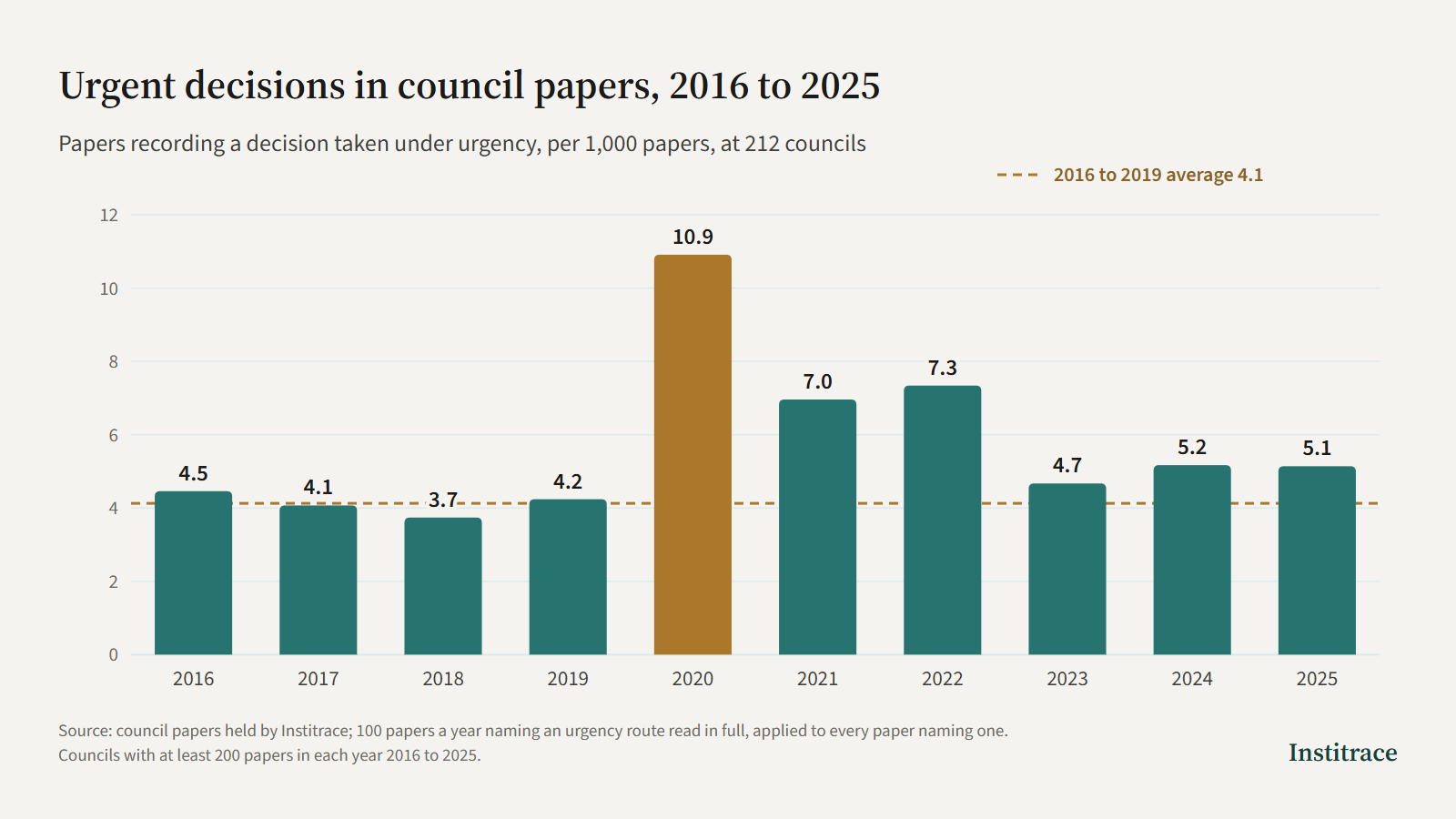
The figures as a table
| Year | Per 1,000 papers | Sample read | Of which recording an urgent decision |
|---|---|---|---|
| 2016 | 4.5 | 100 | 33 |
| 2017 | 4.1 | 100 | 28 |
| 2018 | 3.7 | 100 | 26 |
| 2019 | 4.2 | 100 | 29 |
| 2020 | 10.9 | 100 | 49 |
| 2021 | 7.0 | 100 | 36 |
| 2022 | 7.3 | 100 | 39 |
| 2023 | 4.7 | 100 | 26 |
| 2024 | 5.2 | 100 | 29 |
| 2025 | 5.1 | 100 | 28 |
Land disposal decisions taken under urgency, in papers on disposals at less than best consideration, 2016 to 2026
| Council | Site | Paper | Route | Reason the paper gives |
|---|---|---|---|---|
| Hyndburn | Milnshaw Park | Oct 2016 | Urgent decision | BIFFA funding application deadline and requirement for lease to be in place |
| Dartford | Land at Stone Lodge | Feb 2017 | Special urgency | Agreement with Education Funding Agency for new secondary school needed as soon as possible |
| Sefton Metropolitan Borough | South Sefton College, Sterrix Lane, Litherland L30 2DB | Jul 2017 | Special urgency | Start of Colleges academic year on 1 August |
| Sefton Metropolitan Borough | Land to Hugh Baird College | Sep 2017 | Special urgency | Start of the Colleges academic year on 1 August |
| Hyndburn | Higham Playing Fields in Accrington | Oct 2018 | Urgent decision | To ensure the most up to date legal information is provided |
| Leeds | Allerton Church of England Primary School | Dec 2018 | Call-in waived | Delay would seriously prejudice the Council's or public interests |
| Derbyshire Dales | Matlock Bath Station Yard Car Park | Jan 2019 | Urgent decision | Network Rail permanent closure of level railway crossing threatened Heights of Abraham operation |
| Warrington | Bewsey and Dallam Hub | Feb 2019 | General exception | Negotiations completed faster than expected; contract to commence at earliest opportunity |
| Bath and North East Somerset | Properties and development sites | Jan 2020 | Call-in waived | Council committed to transfer assets and staff by 1 February 2020; duty of care to staff |
| Coventry | 8-12 Ironmonger Row, 17-21 Cross Cheaping, Coventry | Mar 2020 | Call-in waived | Contractual deadline which the developer needs to meet |
| Leeds | Leeds Media Centre | Dec 2020 | Call-in waived | Short timescales provided by ESIF appraisal process |
| Kirklees | George Hotel | Jan 2021 | Call-in waived | Not stated |
| Hyndburn | King George V Playing Fields, Car Park & Associated Changing Pavilion | Mar 2021 | Urgent decision | To ensure the latest up to date information |
| Guildford | Midleton Industrial Estate | Apr 2021 | Urgent decision | Delay would lead to rising development costs |
| Guildford | Weyside Urban Village Development | Jul 2021 | Special urgency | Terms of transaction amendments recently agreed and due diligence completed |
| Coventry | 49-51 Corporation Street | Jul 2021 | Urgent decision | Urgent need to complete surrender and regrant of new 150 year lease for Belgrade Theatre phase 3 development |
| Staffordshire | Former power station site, Rugeley | Feb 2022 | Call-in waived | Time-sensitive DfE agreement and construction timeline |
| Cumberland | Old Gaol site (English Street and Victoria Viaduct properties) | Feb 2022 | Call-in waived | Call-in procedures would overlap the City Council meeting on 1 March 2022 |
| Somerset | Coal Orchard regeneration scheme | Jul 2022 | Urgent decision | Limited ability to establish special Full Council meeting during pre-election period |
| Slough | Montem Lane | Feb 2023 | Urgent decision | Exchange of contracts due 17 February 2023; delay would be prejudicial to Council's best interests |
| Slough | 380 Bath Road, Slough | Apr 2023 | Call-in waived | Minimise the risks to the Council if completion was to be delayed |
| Slough | 233-249 High Street, Slough | May 2023 | Urgent decision | Time critical approval needed to protect commercial interests |
| Tunbridge Wells | Royal Victoria Place, Royal Tunbridge Wells | Oct 2023 | Call-in waived | Delay would seriously prejudice the Council's or the public's interest |
| Slough | Site of Former Merry Makers PH, Langley | Nov 2023 | Call-in waived | Condition of the market and nature of asset at risk of fly tipping and squatters |
| Barking and Dagenham | Former Chaseview Care Home, Dagenham Road, Rush Green, Romford | Jan 2024 | Urgent decision | Urgent action taken by Chief Executive to enable Council to submit bid |
| Slough | Land outside Arbour Vale School gates, held by the HRA | Jun 2024 | Call-in waived | Timescales to enter into contract |
| Islington | 45 and 69 Old Street | Sep 2024 | General exception | Leaseholder threatened administration; risk of losing rental income if not accepted promptly |
| Hyndburn | Mercer Hall, Great Harwood | Mar 2025 | Call-in waived | Not stated |
| West Northamptonshire | Abbey Retail Park, Daventry | Jul 2025 | Urgent decision | Decision needed urgently to permit new Aldi store to open for Christmas |
| Blackburn With Darwen | Land at Staffa Crescent/Knuzden Brook | Sep 2025 | Call-in waived | THG's funding requirements and deadline of 1st October 2025 |
| Northumberland | Former Hexham Fire Station Site | Dec 2025 | Urgent decision | Continuing uncertainty surrounding the future of the asset was preventing the Council's ability to progress important steps |
| Cumberland | English Street, Carlisle | Sep 2026 | Special urgency | Not stated |
Still to come: land declared surplus
Before a council sells or leases a site it no longer needs, it usually declares it surplus to requirements. That decision, recorded in a cabinet report, a committee minute or a delegated decision, is the earliest public sign that a site may change hands.
Since January 2024 councils' papers have declared, or proposed to declare, 1,938 sites surplus, at 223 councils. For 1,692 of them the papers do not yet record an agreed sale. 413 are parcels of land and 405 buildings; 205 are community buildings, 134 open spaces, 121 offices, 102 car parks and 96 schools. Site names include 59 libraries and 53 farms or farm estates. Where the papers say what happens next, sale is the most common, for 960 sites, followed by redevelopment and housing.
Birmingham has the most, 103, as it sells assets after its 2023 section 114 notice. Surrey has 88, most with a sale already agreed; Leeds 73, many of them community buildings; Slough 72; and Devon 63, mostly land and county farms. Recent examples: Derby declared the Walbrook Nursery School site surplus in September 2026 (paper), and Norfolk's cabinet considered county farm estate properties in the same month (paper).
Each council's page on Institrace lists its papers as Institrace collects them, so a new declaration shows there soon after the council publishes it.
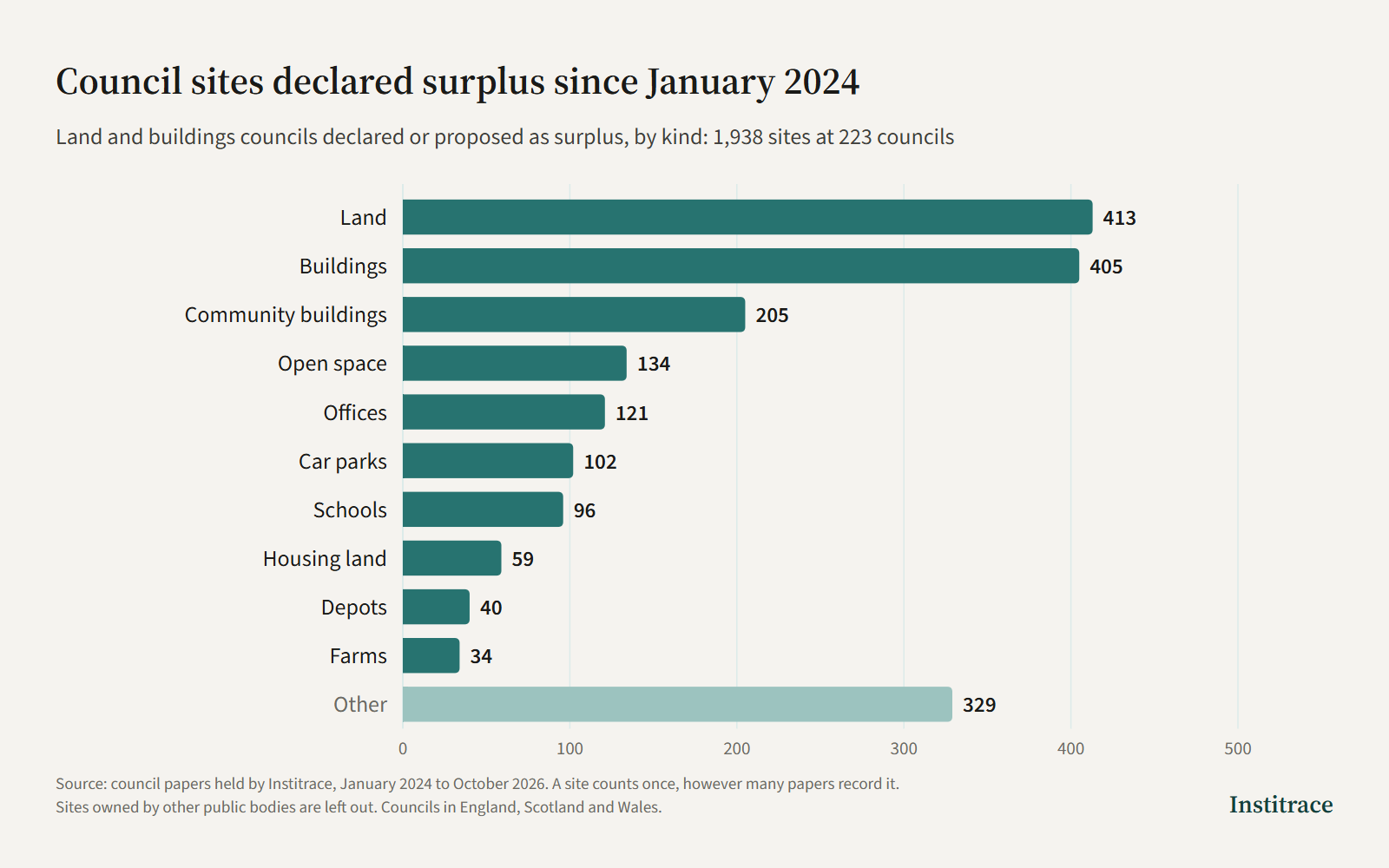
The figures as a table
| Kind of site | Sites |
|---|---|
| Land | 413 |
| Buildings | 405 |
| Other | 329 |
| Community buildings | 205 |
| Open space | 134 |
| Offices | 121 |
| Car parks | 102 |
| Schools | 96 |
| Housing land | 59 |
| Depots | 40 |
| Farms | 34 |
Councils with the most sites declared or proposed as surplus in their papers, January 2024 to October 2026
| Council | Sites | No sale agreed in the papers | Most common kind |
|---|---|---|---|
| Birmingham | 103 | 84 | Buildings |
| Surrey | 88 | 37 | Buildings |
| Leeds | 73 | 58 | Community buildings |
| Slough | 72 | 67 | Buildings |
| Devon | 63 | 63 | Land |
| Aberdeenshire | 43 | 43 | Buildings |
| Wirral | 41 | 39 | Buildings |
| Dumfries and Galloway | 41 | 41 | Land |
| Gateshead | 40 | 38 | Buildings |
| Tameside | 33 | 31 | Land |
| Bristol | 33 | 33 | Buildings |
| Kirklees | 31 | 30 | Land |
| Cheshire West and Chester | 30 | 22 | Community buildings |
| Wiltshire | 29 | 28 | Land |
| Pembrokeshire | 29 | 27 | Land |
Method and sources
Receipts: MHCLG's Capital Outturn Returns time series, 2018-19 to 2024-25, published 24 March 2026, for every English authority. The figure is the disposal of tangible fixed assets across all services (land, buildings, vehicles and equipment, mostly land and buildings), less the same line for the Housing Revenue Account, which is mostly council homes sold under the Right to Buy. Real terms use HM Treasury's GDP deflators of September 2026, 2024-25 prices. In 2024-25 three councils did not submit a return (North Warwickshire, Dudley and Derbyshire); MHCLG's England figure is grossed up for them.
Papers: every council paper Institrace holds, published from 1 January 2016 to 9 October 2026, that contains the phrases less than best consideration, best consideration reasonably obtainable or general disposal consent (9,331 papers); every council paper published from 1 January 2024 containing declared surplus, surplus to requirements, surplus to operational requirements or surplus to the council's requirements and a word for land or property near it (8,959 papers); and, for the urgency rate, 100 papers a year from 2016 to 2025, drawn at random from those naming an urgent decision, special urgency, general exception or an urgency procedure.
Reading: the text around each mention, up to eight passages a paper, was read by a language model (Claude Haiku 4.5) that recorded, for each disposal, the site, the recipient, the kind of disposal, the price or rent as printed, the market or book value where given, the consent relied on, the stage and any urgency route, with an exact quote for each answer. Policy documents, constitutions, asset strategies and passing references were set aside. Each paper on a below-value disposal was then searched in full for urgency wording, and every passage found was read again for whether urgency applied to a disposal.
Counting: one disposal or site counts once. Papers of the same council naming the same site (a report, its agenda pack and the minutes) are joined by the words of the site's name. A disposal is dated by its first paper. Sites the papers say belong to another public body or a private owner are left out of the surplus count. A site counts as having no sale agreed unless a paper records an agreed buyer or terms. Recipients that are private individuals are not named.
Urgency rate: the share of the sampled papers that record an actual decision taken under urgency, rather than template wording or a constitution, applied to the number of papers naming an urgency route each year, per 1,000 of all papers at the 212 councils with at least 200 papers in every year from 2016 to 2025. With 100 papers a year, each year's share has a margin of about 9 percentage points either way.
Limits: the counts are of what councils published and Institrace holds. Some councils publish few papers from earlier years, and decisions made by officers under delegation are not always published, so the figures are a floor. The urgent disposal count covers papers on below-value disposals; sales at full value decided under urgency elsewhere are not counted. These figures say nothing about whether any decision was right.
- MHCLG, Local authority capital expenditure and receipts in England: final outturn time series2018-19 to 2024-25, published 24 March 2026. OGL v3.0.
- Local Government Act 1972, section 123
- Local Government (Scotland) Act 1973, section 74
- Circular 06/03: disposal of land for less than the best consideration that can reasonably be obtained (General Disposal Consent 2003)
- The Local Authorities (Executive Arrangements) (Meetings and Access to Information) (England) Regulations 2012
- HM Treasury, GDP deflators at market pricesSeptember 2026.
Data to download
- Council land disposals below best value, 2016 to 2026 (CSV)One row for each of the 1,603 disposals: council, region, site, town, date of the first paper, stage, recipient and its kind, kind of disposal, price or rent and market value as printed, consent route, who decided, any urgency route, the number of papers and a link to the first.
- Council sites declared surplus, by council, 2024 to 2026 (CSV)One row a council: sites declared or proposed as surplus since January 2024, those with no sale agreed in the papers, and the sites by kind, with a link to the council's page.
- Urgent decisions in council papers, 2016 to 2025 (CSV)One row a year: papers at the 212 councils, papers naming an urgency route per 1,000, the sample read, those recording an urgent decision, and the rate per 1,000 papers.
- Councils' capital receipts from land and buildings, England, 2018-19 to 2024-25 (CSV)One row a financial year, in £ thousands: receipts from tangible fixed assets, the council housing part, land and buildings outside council housing in cash and in 2024-25 prices, and spending on buying land and buildings.
Cite this report
Institrace (2026), Council land disposals: below value, decided urgently, and still to come, https://www.institrace.co.uk/reports/council-land-disposals, accessed 9 October 2026.
How Institrace found this
- council papers searched, 2016 to 2026
- 3,826,497
- papers read for this report
- 20,213
- councils with a below-value disposal in their papers
- 216
- capital outturn returns joined to councils
- 3,076
Institrace holds the papers councils publish: committee reports, agenda packs, minutes and decision notices, 3,826,497 of them from councils in England, Scotland and Wales since 2016. It searched them all for the legal phrases that mark a disposal below best value and a site declared surplus, using an index of every pair of neighbouring words in every paper, so a phrase is found in a paper of any age.
It then read 20,213 papers, recording each disposal and site with the words that show it, and joined the papers that describe the same site. Every figure in this report links back to the papers: the downloads give the first paper for each disposal, and each council's page lists the rest.
The national receipts come from MHCLG's capital outturn returns, which Institrace now holds for every English council from 2018-19, joined to each council by its ONS code. They show how much councils raise; the papers show what was sold and on what terms.